



Feeling nostalgic for the days when I lived in Canggu, before it became the island hotspot, I leave the crowded beaches of the south behind and head north in search of the real Bali. When Gunung Agung suddenly appears before me, I know I am on the right track.
There is nothing quite like coming face-to-face with a volcano, and this, the largest in Bali’s chain of volcanoes, is a beauty. Translating as “great mountain”, Gunung Agung soars to 3000m, and is revered by Balinese Hindus as the realm of the gods. Impressive at ground level, when seen from the air (or the rim, if you brave the gruelling climb), it’s a stark reminder that the island lies in the Ring of Fire. Read the full story in Escape here

There are few things as sought after, nor as elusive as happiness, but what exactly is happiness? Are we born with it? Is there a secret source that we can tap into, or is our obsession with being happy actually dooming us to a life of discontent?
Delving into the question of happiness leads us deep into alabyrinth of spirituality, philosophy, religion, gender, culture, biology and psychology. It is the subject of thousands of books, countless contemplations and endless exploration by neuroscientists. But does it really have to be so complicated? Can’t we break it down and come up with some kind of cheat sheet for happiness? Actually, thanks to the rise of the positive psychology movement, happiness has been taken out of the esoteric realms and planted firmly in the scientific arena, and the formula is surprisingly simple. First, we need to find out where to look.
For sure we are all familiar with the thrill of pleasure-based happiness, that warm fuzzy feeling that comes when something good happens – a promotion at work, an exotic beach holiday, or even the simple joy of snuggling up to someone you love. We live for these good times, they make life worthwhile, but these moments are fleeting as they are emotional responsesto a set of circumstances. We can’t be laughing all the time, leaping from one high to another, constantly feeling on top of the world, it’s just not sustainable. Besides, people would think we were mad. Even so, it is common to get dragged down by unfulfilled expectations of happiness. As Darrin McMahon, author of Happiness: A History points out, “The idea of happiness as our natural state is a peculiarly modern condition that puts a tremendous onus on people. We blame ourselves and feel guilty when we’re not happy.”
So, have we been looking for happiness in all the wrong places? SBS poses this question to Japanese-born Eiji Han Shimizu, who produced the multi-award winning documentary, Happy, and provides the perfect analogy. “I studied hard, exercised, had a good job; I had a convertible and a beautiful girl on my arm. I had all the ingredients of happiness, but I discovered that in my pursuance of happiness, I had climbed the wrong mountain.” Intrigued by the concept of finding genuine, lasting happiness, he and his friend, renowned director, Roko Belic, embarked on a six-year quest around the world to make Happy.
From the seething streets of Calcutta, to the dizzying heights of Bhutan, the misty Bayou swamps of Louisiana and into the neuroscience labs of top universities, the pair were on a mission to find a universal formula for happiness. Shimizu describes a moment, after many months on the road when they had an epiphany of the, “Oh my God did you see that?” variety. They had discovered a commonality in happy people around the globe. It was contentment! “There aren’t selfish happy people, there aren’t egotistical happy people,” says Shimizu.
“Most of us look for happiness outside, such as compliments, money, physical gratification,” yet they discovered the most extraordinarily happy people were those that didn’t have much at all, but were content; they had a skill of looking within, as well as “a certain presence typified by humility, warmth and good heartedness.”
Neuroscientists and psychologists agree. Life is hard, it’s full of ups and downs, but happy people have a way of turning inwards and dealing with situations, rather than waiting for external conditions to provide them with happiness. We all know the dream – the one where you win the lottery and live happily ever after, but an experiment Lottery winners and accident victims, revealed suprising results. Researchers interviewed people who had won the lottery and those who had been paralysed in traumatic accidents. Of course the lottery winners were the happiest in the moment, but fast forward six months and there wasn’t a huge difference in happiness levels, in fact the accident victims reported more joy from simple daily pleasures, such as chatting with friends or sharing a joke. It is called hedonistic adaptation. You see, happiness is subjective, it’s feeling better than we did the day before.
While traditionally neuroscience concentrated on the triggers for depression and mental illness, the relatively new positive psychology movement examines human flourishing. This science of happiness, has narrowed the ‘feel-good centre’ of our brain down to the left prefrontal cortex, which is more active when we are happy. Sonja Lyubomirsky Psychology Professor, and author of The How of Happiness, claims that up to 50% of our happiness is genetically pre determined. Another 10% is dependent on our circumstances – our jobs, where we live etc., but the remaining 40% is based on daily activities and recent experiences – which means we potentially have the opportunity to get happier by changing our behavior. The human brain is highly malleable, and the process of neuroplasticity allows us to create new neural pathways, which is why Cognitive Behavioral Therapy – which restructures thought processes – is so effective in treating depression and anxiety. Much like we exercise our muscles to get physically fit, we can also train our minds to create a habit of happiness. You could look at it as a scientifically-backed daily happiness work out.
Happiness Cheat Sheet
*Practice random acts of kindness. Ever heard of the ‘helper’s high’? Neuroscience proves that acting with a true spirit of generosity releases endorphins (the body’s natural opiates.)
*Be compassionate. Understand what others are experiencing, it will give you greater connection.
*Develop resilience. Bad things happen to us all, but quite often it’s the thoughts attached to something, and not the event itself that causes the most suffering.
*Be optimistic. Why feed the darkness? Life is much more enjoyable when you look on the bright side.


Published in Insight Magazine, Bali
The Indonesian archipelago is home to the richest assortment of coral species in the world, but its reefs are vanishing as global warming, pollution and unsustainable fishing and tourism practices take their toll.
Indonesia’s appalling conservation record is well documented and it would be easy to write yet another article about imminent disaster; but I am sick of all the doom and gloom, because with destruction comes regeneration. While politicians and environmental agencies gather in endless global summits and engage in pointless debates about how to fix things, often the most effective change is happening at a grassroots level, and I knew that somewhere in Bali someone would be doing something to save the reefs.
I find my story in the north of the island, in a humble village that sits in the shadows of the mountains. Just meters off Pemuteran’s black sandy shore lies the Karang Lestari (Everlasting Reef) Project, one of the largest and most ambitious coral restoration projects in the world. A reef that had badly damaged is once again thriving due to a unique technology called Bio-Rock, which uses electric currents to stimulate the growth of coral.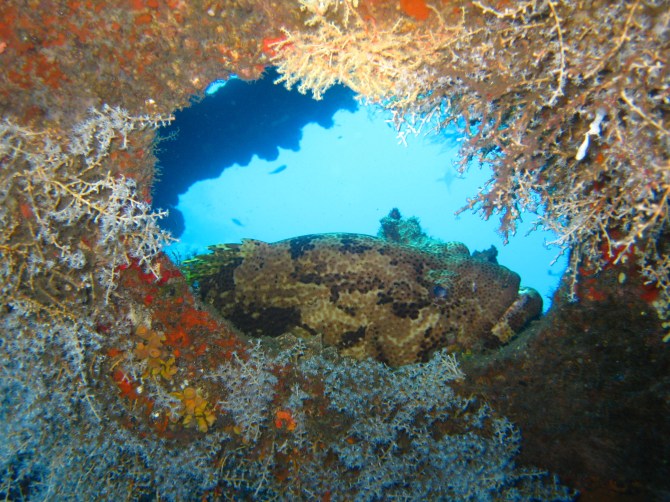
All coral photographs courtesy of Rani E. Morrow-Wuigk
I have no idea what to expect, but this is unbelievable, a kind of futuristic underwater fantasy world. Fifty large steel structures span over 1000 feet and take the form of a caterpillar, a whale, an igloo, a dome, a tent, and a flower, all covered in a profusion of brightly coloured coral. Hundreds of tiny blue fish hover above the dome, bat fish flitter amidst the flowers. I see starfish, lionfish, a school of snapper and cheeky little Nemos everywhere. Soft pastel corals sway in the current and purple tipped table corals sprawl across the metal bars. The reef surrounding the structures is also thriving, everywhere I look I see life and vibrant colour. Natural power is the plan for future structures (which includes a Goddess rising from a lotus.) Reef Seen Aquatics Dive Center have already set things in motion, sponsoring two structures, a bio wreck and a giant turtle that are powered by solar panels. Continue reading “Bio Rock: Saving the reefs”

I drive up to Ubud early in the morning, dark ominous clouds hang over the hills creating a moody backdrop. I hope the rain will hold off for the next few hours as I have signed up for a herbal walk, and trudging through rice fields in torrential rain isn’t quite what I have in mind. Continue reading “A walk on the wildside”
Singapore, a gleaming metropolis of soaring skyscrapers, manicured gardens, and people in suits; where shopping malls are supersize, electronics are truly king, and chewing gum is illegal. I have passed through the city many times, but never considered it as more than a brief stop on my way somewhere else. Now I have a three-day visa run and am determined to get a glimpse into life beyond the shiny facade. I catch a bumboat to Pulau Ubin, a small island that is home to one of the last remaining kampoengs (traditional villages in Singapore).


Published in The Bali Advertiser
The human connection to crystals and stones spans time, cultures, continents and religions. Ancient Sumerians included crystals in their magic formulas; Egyptian pharaohs had their headdresses lined with malachite in the belief that it helped to rule wisely; while native American shamans used them for divination and healing. Their curative properties are mentioned repeatedly in ancient Vedic Hindu texts and referred to in the Old Testament of the Bible; while the mysterious black stone at Mecca (possibly a meteorite) forms an intrinsic part of the Islamic pilgrimage.
In 1880 Jacques and Pierre Curie discovered the piezoelectric property of quartz – when squeezed or stretched, a voltage is produced across the crystal’s face. These days crystals are utilized in almost every form of technology. Liquid Crystal brings us the clarity in our computer screens, quartz keeps watches ticking, and electronic grade crystals are used in cell phones, clocks, games, television receivers, radios, computers and navigational instruments. But although science readily accepts the vibrational qualities of crystals, when it comes to the less tangible realms of crystal therapy, the suggested positive vibrations of gemstones is often relegated to the fringe of ‘new age;’ even though it is a tradition that is about as ‘old age’ as you can get. We have been communing with stones in one way or another for as long as we have roamed the earth. Continue reading “Can Crystals heal?”

A version of this story was published on SBS Life
Determined to remember their life outside of cancer, a young family hit the road for an epic six-week, 10,000 km trip across Australia, chasing dreams, building memories and finding solace in the wide open spaces of the outback.
“Cancer is just a word. It doesn’t have to be our reality. This is a love story about living cancer, not surrendering. It’s about making every moment count,” says Sarah Widodo, whose husband, Catur Widodo, has Pseudomyxoma Peritonei – a rare and terminal cancer of the appendix. They have two children, ten-year old Jala and four-year old Kyan. “We wanted to create happy memories for our two boys and to gift Catur some adventure in his life,” Sarah tells SBS. “We had always been gypsy nomads before cancer made us stagnant, stuck inside a system, reliant on medical help. A road trip helped us remember who we are. Cancer is just a small piece of the story.” Continue reading “Living with Dying”
 Travel Media Specialist