





Published in Insight Magazine, Bali
The Indonesian archipelago is home to the richest assortment of coral species in the world, but its reefs are vanishing as global warming, pollution and unsustainable fishing and tourism practices take their toll.
Indonesia’s appalling conservation record is well documented and it would be easy to write yet another article about imminent disaster; but I am sick of all the doom and gloom, because with destruction comes regeneration. While politicians and environmental agencies gather in endless global summits and engage in pointless debates about how to fix things, often the most effective change is happening at a grassroots level, and I knew that somewhere in Bali someone would be doing something to save the reefs.
I find my story in the north of the island, in a humble village that sits in the shadows of the mountains. Just meters off Pemuteran’s black sandy shore lies the Karang Lestari (Everlasting Reef) Project, one of the largest and most ambitious coral restoration projects in the world. A reef that had badly damaged is once again thriving due to a unique technology called Bio-Rock, which uses electric currents to stimulate the growth of coral.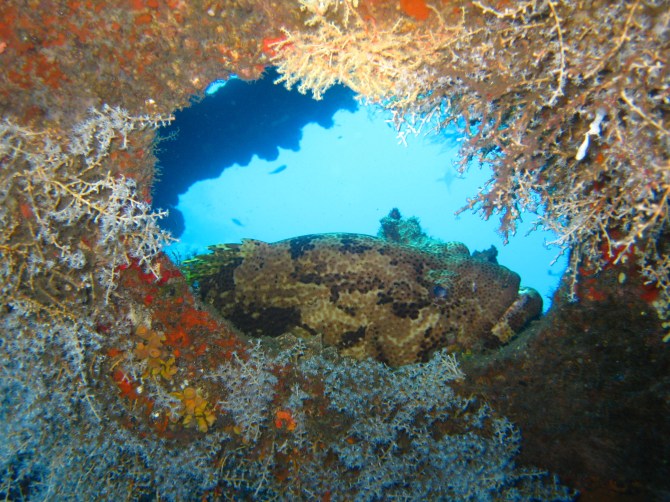
All coral photographs courtesy of Rani E. Morrow-Wuigk
I have no idea what to expect, but this is unbelievable, a kind of futuristic underwater fantasy world. Fifty large steel structures span over 1000 feet and take the form of a caterpillar, a whale, an igloo, a dome, a tent, and a flower, all covered in a profusion of brightly coloured coral. Hundreds of tiny blue fish hover above the dome, bat fish flitter amidst the flowers. I see starfish, lionfish, a school of snapper and cheeky little Nemos everywhere. Soft pastel corals sway in the current and purple tipped table corals sprawl across the metal bars. The reef surrounding the structures is also thriving, everywhere I look I see life and vibrant colour. Natural power is the plan for future structures (which includes a Goddess rising from a lotus.) Reef Seen Aquatics Dive Center have already set things in motion, sponsoring two structures, a bio wreck and a giant turtle that are powered by solar panels. Continue reading “Bio Rock: Saving the reefs”

I drive up to Ubud early in the morning, dark ominous clouds hang over the hills creating a moody backdrop. I hope the rain will hold off for the next few hours as I have signed up for a herbal walk, and trudging through rice fields in torrential rain isn’t quite what I have in mind. Continue reading “A walk on the wildside”
Singapore, a gleaming metropolis of soaring skyscrapers, manicured gardens, and people in suits; where shopping malls are supersize, electronics are truly king, and chewing gum is illegal. I have passed through the city many times, but never considered it as more than a brief stop on my way somewhere else. Now I have a three-day visa run and am determined to get a glimpse into life beyond the shiny facade. I catch a bumboat to Pulau Ubin, a small island that is home to one of the last remaining kampoengs (traditional villages in Singapore).


A version of this story was published on SBS Life
Determined to remember their life outside of cancer, a young family hit the road for an epic six-week, 10,000 km trip across Australia, chasing dreams, building memories and finding solace in the wide open spaces of the outback.
“Cancer is just a word. It doesn’t have to be our reality. This is a love story about living cancer, not surrendering. It’s about making every moment count,” says Sarah Widodo, whose husband, Catur Widodo, has Pseudomyxoma Peritonei – a rare and terminal cancer of the appendix. They have two children, ten-year old Jala and four-year old Kyan. “We wanted to create happy memories for our two boys and to gift Catur some adventure in his life,” Sarah tells SBS. “We had always been gypsy nomads before cancer made us stagnant, stuck inside a system, reliant on medical help. A road trip helped us remember who we are. Cancer is just a small piece of the story.” Continue reading “Living with Dying”

Teenage sisters are leading the fight to clean up Bali with their campaign Bye Bye Plastic Bags. From flash mobs, to collaborations with the Balinese Governor, to a standing ovation at their recent Ted Talk in London, the girls are also inspiring youth around the world to make a stand for what they believe in.
Colourful plastic bags are gleefully handed out across the island, used once and then abandoned. They flit across the emerald rice fields, float from wave to wave in the churning sapphire sea, and smoulder in smoky backyard fires. Of the 700 cubic meters of plastic garbage (that’s like a 14-story building) generated every single day in Bali, only about 5% of plastic bags are recycled.
“We all love Bali as the island of temples, smiles and rice fields, but now it’s more famous as the island of garbage,” say Balinese sisters Melati and Isabel Wijsen. Three years ago the girls, then aged 12 and 10, decided that enough was enough, and set out on a mission to rid Bali of single use plastic bags. They might have been young, but as students of Bali’s renowned Green School, they knew a lot about the problems with plastic, and had the enthusiasm and courage of youth to fight for what they believed in. “Seven years ago Bali wasn’t ready, but we have been boiling up awareness. Now it is ready,” they tell SBS. “We are already seeing increasing awareness in the villages, people are starting to realise that rubbish isn’t going away, they have to take responsibility.”
Operating under the banner Bye Bye Plastic Bags the girls launched a petition on Facebook one evening to ban single use plastic bags from Bali. To their astonishment 6000 people signed overnight and to date their team of teenage volunteers have collected more than 80,000 signatures (on and off line.) They also stage beach clean ups, eco festivals and educational workshops, speak at international conferences and have established a plastic-free pilot village. Again and again they have discovered the incredible power of social media to reach a global audience.
For two years they tried, but failed to get the attention of Bali’s Governor Pastika and finally decided to imitate their hero, Mahatma Gandhi, and go on hunger strike. Actually, their parents vetoed the hunger strike idea, so they opted instead for a food fast – refusing to eat between sunrise and sunset. An announcement was made on Facebook and within two days the sisters were sitting in the Governor’s office. He was impressed by the “Child-led social initiative,” and offered his full support. The girls now work with the Bali Provincial Environmental Agency, who made an official statement in 2015 that Bali will be plastic bag free by 2018.
“We have had kids reaching out from all over the world,” say the sisters. “Our campaign is encouraging people to become leaders, kids are beginning to realise they are the change- makers.” Branches of Bye Bye Plastic Bags were recently launched in Myanmar, New York City and Australia – by 16-year-old Billy Barge. “The girls inspired me to get up and make a change,” he says. “We can’t sit and watch our inheritance crumble away in front of us. Kids have the power to make a change.” He encourages anyone who wants to get involved to contact him at Bye Bye Plastic Bags Australia.
17-year-old environmental activist, Suman Khadka also collaborated with the girls to set up Bye Bye Plastic Bags Nepal and in so doing forged a connection that would bring much-needed aid to his mountain village following last year’s cataclysmic earthquake. With most of the village destroyed, and many dead or dying, Khadka posted an urgent appeal for help on Facebook. Melati responded immediately. “I hardly knew her, we had only connected through Facebook,” says Suman, “But she was ready to help. That moment was so incredible that it cannot be expressed in words it can only be felt. It was one of the happiest moments of my life.”
Swinging into action the girls raised $40,000 in just over a week. They wanted to personally deliver the money to Nepal, but their parents worried for their safety, so instead their Dad and some other parents of the Bye Bye Plastic Bags team volunteered to go. The group from Bali went on to visit Nepal three times, treating people in a makeshift first aid clinic and distributing over 20 tons of rice, hundreds of food packages, tarps, water filters and lanterns.
So, what does 2016 hold for these teenage Balinese eco warriors? “Our goals are education – because that’s where the change will happen; going global; and making sure that our voice, the voice of the youth is heard on a political level,” say Melati and Isabel. “Us kids may only be 25% of the world’s population but we are 100% the future.”
My Days as a Deadhead, published in Farang Untamed Travel 2005

Jerry Garcia, singer, songwriter and founding force of the Grateful Dead was a larger- than-life character, hailed by many of his fans as a Messiah-like figure. When he died in 1995, 20,000 people gathered in San Francisco for a candle-light vigil. Shortly after, the band announced their split and to many it seemed like the end of an era. But time has proved otherwise Continue reading “Living with the Dead”

The jungle rises steeply in front of us and we cross the river balanced precariously on a dug out canoe. The wall of dense green foliage looks impenetrable but a narrow, muddy trail has been carved out and the ranger leads us to a small clearing and a feeding platform. We only have to wait a couple of minutes before an orangutan comes swinging gracefully through the trees. It’s a female, and her scrawny baby clings on tightly as she stuffs bunches of bananas into her mouth and scoffs handfuls of milk from the rangers bucket. Continue reading “Into the wild: Sumatra”
 Travel Media Specialist